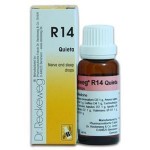
Dr. Reckeweg R 14 Quieta Nerve and Sleep Drops Indications: Insomnia and various disturbances of the sleep, superficial sleep, light sleep, sleeplessness, drowsiness in the morning, weariness during the day, vivacity in the evening. Nervous restlessness and over-excitement of the nervous system. Neurasthenia, consequences of mental conflicts of long duration. Mode of Action of Main Ingredients Influences favourably the regularizing of disturbed sleep, and neurasthenic symptoms. Ammonium bromatum: Sedative. Avena sativa: General nervous weakness and sexual neurasthenia, consequences of mental overexertion. Convalescence. Sleeplessness in spite of lassitude. Chamomilla: Effective in overstimulated nervous system with hypersensitivity. Uneasy sleep. Eschscholzia: Sedative. Humulus lupulus: General nervous exhaustion, neurasthenia, hypochondria, sedative. Ignatia: Nervous exhaustion and irritability resulting from psychic afflictions of a depressing nature, following grief or worry. Egocentric solitude. Passiflora incarnata: Sedative. Unrest and irritability of the nervous system. Mental and physical vivacity when trying to sleep, full of ideas, disturbed non-refreshing sleep Valeriana: Light sleep, non-refreshing. Nervous weakness and restlessness. Zincum valerianicum: Insomnia with twitching in limbs, nightmares, restlessness of the legs. Dosage: In extreme nervous exhaustion and insomnia, 3 times a day 10-15 drops in some water, at night 20 drops in some sweetened water. In most cases general relief and a less agitated sleep follow after several days. Thereupon, 10-15 drops once or twice daily ought to suffice. However, R14 acts differently on various individuals. Patients sensitive to medicine very often experience an aggravation, chiefly of insomnia. In such cases the dose should immediately be reduced to 5 drops 3 times a day, sometimes even less, even down to once only during the day (not recommended in the evening). Dosage should be adapted to the individual. In some cases, 20-30 drops 3 times a day may have to be taken to obtain any effect. However, before increasing the dose it would be advisable to observe the action of the medicine for several days.Regular treatment should be continued for a longer period of time even after complete recovery, at the rate of 10-15 drops taken in the evening. Remarks: In general nervous exhaustion, the simultaneous use of VITA-C15 will give best results.
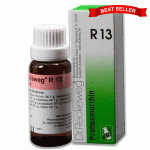
Dr. Reckeweg R 13 Prohaemorrhin Hemorrhoidal Drops Indications: Hemorrhoids, itching, pains, bleeding, anal fissures, anal prolapsus, anal eczema, plethora. Mode of Action of Main Ingredients Acidum nitricum: Stabbing in the intestine, splinter pain, sensation of constriction during defecation with persistent pain after stool. Aesculus: Dryness and burning of external hemorrhoidal mucosa (dark red prolapsing hemorrhoids). Dull pains in sacral region, venous stasis. Collinsonia canadensis: Venous congestion in the pelvis, obstipation, flatulence, hematogenic hemorrhoidsGraphites: Constipation, glairy lumpy stools, flatulence, anal eczema, itching. Hamamelis: Varices, bleeding, hemorrhoids. Kalium carbonicum: Backaches, flatulence. Hard stools, burning anal node. Lycopodium: Meteorism, flatulence, dry stool with incomplete defecation. Hematogenic hemorrhoids with prolapse and anal spasm. General hypochondria and dyspepsia, constipation, abdominal plethora. Paeonia: Wet hemorrhoids, painful anal fissures. Sulfur: Remedy with extensive effectiveness, anal redness, itching, exzema, unhealthy skin. Dosage: Generally 10-15 drops in some water 3 times daily. In acute pains, in the beginning of the treatment, 10-15 drops 4-6 times a day. After complete disappearance of the affliction, continue a treatment with 10-15 drops once or twice a day for a longer period of time. It is of great importance to regulate the stools at the same time, in case of constipation. Therefore, laxative nutrition should be recommended for breakfast and supper such as: cooked fruits, linseed, green peas, ryebread, sourcrout, yogurt etc. Constipating foods such as: white bread, cacao, starches etc., should be avoided. Remarks: In simultaneous liver complaints, use also R7, 3 times a day 10-15 drops before meals, and twice a day 10-15 drops of R13 after meals.In varicosity and venostasis: additionally or in alternation with R42.In anaemia resulting from bleeding hemorrhoids: additionally R31.Sacral back pain in women: see R50.
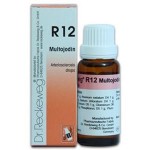
Dr. Reckeweg R 12 Multojodin Arteriosclerosis Drops Indications: General arteriosclerosis and hypertonia. Cerebral arteriosclerosis, aortic and coronary sclerosis, nephrosclerosis, dysbasia, abdominal dyspragia. Senility, weak memory, congestion of blood, vertigo, forgetfulness, tendency towards apoplexy and its consequences, predisposition to goitre, thyreotoxicosis. Mode of action of main Ingredients Extended iodine therapy by using different iodates in combination with active biologic elements. Arnica: Tendency towards apoplexy, favors resorption at the beginning of an apoplectic stroke. Aurum chloratum: Depressive psychosis. Congestion of blood towards the head. Palpitation. Barium chloratum: Progressive loss of memory, unsteadiness and psychic changes, vertigo, deafness and senility. Conium: Vertigo, especially on rising, congestion of blood, loss of memory, psychic changes, general weakness of nervous system , hypersensitivity and impotency. Iodates: Increasing viscosity of bloods, acts on the thyroid glands, hypertonia and general arteriosclerosis. Glonoinum: Congestions in head, strong pulse, oppression in chest and heart. Plumbum aceticum: Pale hypertension with mental dementia. Nephrosclerosis with consequences of apoplexy. Intermittent limping. Dosage: Generally 10-15 drops three times daily, in some water. In acute cases, in the beginning of the treatment, 4-6 times daily. After improvement (taking 2-3 weeks) continue the treatment for a longer period of time once or twice a day. During the treatment the use of salt should be forbidden and only be allowed in small quantities after improvement has set in. In predisposition to goitre and thyreotoxicosis, a treatment of 10-15 drops once a day for about 4-6 weeks is recommended, and should be repeated at intervals of one month. In apoplexy, frequent doses in the beginning, at the rate of 10-15 drops every 1-2 hours, then 4-6 times a day 10-15 drops. Remarks: In simultaneous cardial weakness, use alternatively R12 and R3, each one 2-3 times daily.In myocardial infarct: see R67 and R2.In angina pectoris: alternative with R2.In cardiac insufficiencies: see R3.In cardiac decompensation: R58.In vertigo: alternative with R29.In intermittent claudication, peripheral vascular disturbances, etc: see R63.
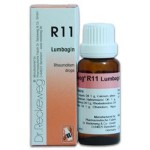
Dr. Reckeweg R 11 Lumbagin Rheumatism drops Indications: Acute and chronic myalgia, lumbago, rheumatic diathesis aftereffects of drenchings, sprains, overstraining. Back pains of unknown genesis. Growing pains in muscles and bones. Sciatica from getting wet, from sitting on cold seat and suppressed perspirations. Chronic articular rheumatism with deformations. Spondylarthritis, spondylosis, sacroiliac arthritis. Rheumatic aches (muscles, articulations, ligaments) growing worse with change of temperature (humidity). Mode of Action of Main Ingredients Berberis: Acute and undetermined pains in the loins. Acid urine, gravel. Calcium phosphoricum: Weakness and muscles of neck and along spine, deformed bones. Rheumatic diathesis, worse in damp weather. Acts on the constitution. Causticum Hahnemanni: Pains in the loins, especially when trying to get up. Painful rigidity of the neck and dorsal muscles. Neuralgic pains. Painful, rigid, di.storted and weak articulations. Rhododendron: Rheumatism especially of the small joints. Aggravation of symptoms before thunder storms, rain and storm. Rhus toxicodendron: Dislocation of limbs, feels as if crushed, consequences of drenching or suppressed sweating. Symptoms grow worse at night and when resting. Better by motion, by heat. Neuralgic rheumatism of limbs and articulations, weakness and rigidity, shivering in sacral region. The pains grow worse with change of weather and in damp cold weather. Improving by warmth. Rheumatic-gouty diathesis often caused by sitting on cold seat. Dosage: In acute pains (lumbago, sciatica), every 1/2 - 1-2 hours 10 drops in some water. Improvement generally sets in after 1-2 days. Then take 10 drops every 1-2 hours and until complete recovery 3 times daily 10-15 drops for some time, in order to prevent a relaps.In chronic muscular and articular rheumatism, spondylo arthritis and spondylosis, 2-3 times a day 10-15 drops in some water until improvement. Then 10-15 drops, 1-2 day for a longer period of time. Remarks: In acute rheumatic polyarthritis, use R1 and R6. In prolapse of intervertebral discs followed by sciatica, etc. administer R71 rather frequently and in alteration.In intercostal neuralgia: additional R69. Sacral back pain in woman resulting from pelvic diseases: R50.In osteo-arthritis: additionally R73. In acute rheumatism of joints: see R1 and R24.Rheumatism of shoulders, arm and hands: see R46.If the disorder is accompanied by osteoporosis, the additional administration of R34 is recommended.In all forms of rheumatism R61 (Rheumatic ointment) and Atomare-Beckeron R30 have proved themselves to be successful. Prod
Dr. Reckeweg R 10 Klimakteran Climacteric Drops Indications: Climacteric complaints, flushes of heat, attacks of perspiration, physical weakness, depression, headaches, irregular menstruations, fluor pruritus vulvae, psychic exhaustion, indifference. Mode of Action of Main Ingredients R10 exerts a favourable biological influence on all ovarian disorders. Acidum sulfuricum: Physical weakness, flatulence, prostration, flushes followed by perspiration, tendency towards hermorrhage, pruritus vulvae. Cimicifuga: Endocrine dysfunction, especially during menopause. Psychogenic depression and excitement. Restlessness. Sanguinaria: Vaso-motoric irritations, alternating heat and cold, nervous irritability, headaches. Sepia: Hormonal effect, Physical and spiritual weariness, exhaustion, lack of energy, sleepiness, indifference. Rush of heat followed by perspiration. Psychic hypersensitivity and irritability. Sinking feeling in abdomen, excessive fluor, irregular menstruations. Dosage: According to the state of acuteness 3-6 times a day 10-15 drops in some water. When improving, reduce the dose immediately to 10-15 drops three times daily. It is advisable to continue the treatment for a longer period of time at the rate of 10-15 drops, 1-2 days, until the physiological transformation of the body has been reached.R10 does not contain hormones, which are usually employed. The additional use of such preparations does not influence its biological effectiveness, but will be unnecessary in most cases. Remarks: R10 also proves to be effective in diseases of the female organs, especially fluor genitalis.In metritis, peri-parametritis, ovariitis, alternate R10 and R1, every 2-3 hours.
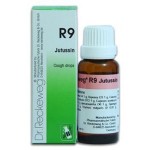
Dr. Reckeweg R 9 Cough Drops Cough Drops Indications: Catarrhal affections of the upper air passages. Rhinolaryngopharyngitis, especially bronchitis and whooping cough at all stages. Effective expectorant in chronic bronchitis, bronchial asthma, fits of coughing in phthisis. Mode of action of main Ingredients: Ammonium causticum: Convulsive cough accompanied by plenty of loose mucus. Belladonna: Convulsive cough attack, hollow and barking cough, dry mucus membranes. Bryonia: Harsh and dry cough with pain in the chest. Chamomilla: Convulsive cough,catarrh and hoarseness with accumulation of tenacious mucus in the throat,dry cough,chiefly in the evening and at night. Coccus cacti: Hypersensitivity of the mucosa of the pharynx. Spasmodic cough with viscous glairy expectorations. Corallium rubrum: Violent attack of convulsic cough with choking fit. Cuprum aceticum: Spasmodic cough, viscous mucus, dyspnea. Drosera: Convulsive cough with cyanosis and suffocation, spasmodic asthma. Ipecacuanha: Dry asphyxiant cough with glottis spasm, nausea and emesia. Spongia: Hollow cough, cough at night. Sticta pulm: Cold down from the nose to the pharynx and trachea, followed by bronchitis. Pressure on the root of the nose. Thymus vulg: Expectorant. Dosage: Whooping cough: In the beginning of the treatment frequent doses, every 1 hour 10 drops in some water, or one teaspoon (5ml) of syrup. Advisable is, to alternate from hour to hour the cough syrup and the coughdrops. After attenuation of the graveness and frequency of the fits of coughing (generally in 2-3 days) take the medicine every 2 hours. In the treatment of non-specific catarrhs, following whooping cough, take 4-6 times daily 10-15 drops in some water, or one teaspoon (5ml) of syrup.Acute bronchitis and laryngo-pharyngitis: Every 2-3 hours 10-15 drops or one teaspoon of syrup. Remarks: In influenza, use also R 6.
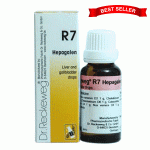
Dr. Reckeweg R 7 Hepagalen Liver And Gallbladder Drops Indications: Organic and functional complaints of liver and gallbladder, hepatopathy, cholecystophathy, calculi, disturbances of the biliary secretion, hepatitis, swelling of the abdomen, premature satiety, lack of appetite, bitter taste in mouth, flatulence, constipation, weariness after meals, irritation, hypochondria. Mode of Action of Main Ingredients Carduus marianus: Painful swelling of the liver, jaundice, biliary calculi, cholangitis. Chelidonium: Swelling of the liver with sensation of pressure on licer and biliary vesicle and extending to right shoulderblade, cholagogue. Cholesterinum: Enlargement of the liver, jaundice and formation of gallstones. Colocynthis: Cramplike pains in abdomen, cannot stand pressure of clothes. At the time a pain occurs, improvement is obtained through strong pressure on abdomen and through bending over. Lycopodium: Meteorism and flatulence, bitter taste in mouth, bad humour, constipation. Nux vomica: Hypochondria, liver constriction and congestion, nausea, abuse of tobacco, icterus, gastro-duodenal catarrh, constipation. Dosage: Generally 3 times a day 10-15 drops in some water before meals.If no improvement occurs within 8-14 days take 10-15 drops 4-6 times a day and reduce the dose when improving. Even after complete disappearance of the complaints, take 10-15 drops 1-3 times a day for a longer period of time, watching diet rigorously. Remarks: In inflammatory diseases of liver and biliary vesicle, additional use of R1. In simultaneous gastric diseases (gastritis, ulcers), use also R5.In ulcers, take 10-15 drops of R5 3 times a day before meals, and 10-15 drops of R7 2-4 times a day between meals.In hemorroids, additional use of R13.
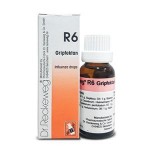
Dr. Reckeweg R 6 Gripfektan Influenza Drops Indications: Acute feverish inflammations of the fibrous tissues and the serous membranes. Gripfektan: Specific serous remedy, especially influenza. General infection with pain in the limbs, sensation of prostration, dull head-aches, restlessness. Dry and burning skin, acute pains. Feverish catarrh of the mucosa of the upper air-passages, rhinopharyngitis, influenza bronchitis, pneumonia, inflammation of the serous membranes, pleurisy, pericarditis, peritonitis, irritation of the peritoneum during inflammatory processes of the abdominal organs. Mode of Action of Main Ingredients Baptisia: Typhic fever, stupor and lethargy, cold, irritation of the mucous membranes. Bryonia: Catarrhal fever, headaches, piercing pains, inflammation of the serous tissues. Camphora: Analeptic, calmative. Causticum: Sensation of rawness of mucosa, hollow cough, weakness of the sphincter of bladder. Eucalyptus: General agitation and accelerated breathing, weariness and rigidity of limbs, headaches, fever. Eupatorium perfoliatum: Fever with sensation of prostration. Catarrhal inflammation of the upper air-passages with tendency to cough and sensation of rawness of mucosa. Ferrum phosphoricum: Remedy for fever and inflammation, low pulse, rush towards the head. Especially effective in inflammations of the upper respiratory tracts and in bronchopneumonia. Gelsemium: Congestive headaches, sleeplessness, shivering and prostration. Sabadilla: Convulsic stimulus of the sneezing centre, burning cold stimulus of the coughing centre, stitches on the chest. Dosage: Acute illness with feverish tendency: 10 drops in some water every 15 to 30 minutes.As soon as fever is abating (generally after 1-2 days) and perspiration appears, take the medicine every 1-2 hours 10-15 drops.When fever has gone, take during several days every 2-3 hours 10 drops in some water.Prevention in influenza epidemics: 3-4 times a day 10-15 drops in some water. Remarks: In acute infection with high fever and inflammation localized mainly in the mucosa of the head (redness, delirium, conjunctivitis), use R1.In bronchitis: see Jutussin® drops R9 and syrup R8.In pleuritis: see R24.Involvement of sinuses: see R49.Above remedies are administered in addition to or in alteration with R6 depending on the symptomatology.Chickenpox: administer additionally R68.
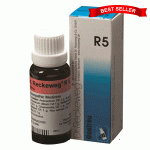
Dr. Reckeweg R 5 Gastreu Stomach Drops Indications: Acute and chronic gastritis, dyspepsia, chronic relapsing gastritis with or without ulceration. Especially ulcus parapyloricum. Heartburn, bad taste in mouth, frequent belching, flatulence, meteorism. Acts on the inflamed mucosa of stomach, on the physiology of stomach. Mode of Action of Main Ingredients Anacardium: Gastric complaints, improving after eating, pains around midnight. Argentum nitricum: Epigastric complaints, noisy and frequent belching with temporary improvement. Arsenicum album: Remedy for mucous membrane, burning pain in the stomach with vomiting. Carbo vegetabilis: Sensation of repletion in abdominal cavity, asthenia and exhaustion. Chamomilla: Nervous hypersensitivity and irritability. Swelling of the stomach. Chelidonium: Effective for liver and bile, choleretic, improvement of gastric disorder by ingestion. Lycopodium: Gastro-intestinal disturbances, bitter taste in mouth, lack of appetite, constipation, flatulent colic. Nux vomica: Nervous irritability, hypochondria, stomach constriction, disturbances due to nicotin. Scrophularia nodosa: Griping pains in abdomen, hyperacidity improving after eating. In some patients, sensitive to drugs, the pains may grow worse after a few days of treatment, which is the socalled primary reaction. In such cases it will be advisable to discontinue the treatment completely for 1-2 days. Resumption of treatment will result in continued improvement. In other cases follow treatment with intermissions, or reduce the dose, or give the drops on a full stomach. It is characteristic in the use of Dr. Reckeweg R5, to see the usual relapses decrease progressively in graveness and frequency, until they disappear completely. Dosage: Generally 3 times a day 10-15 drops in some water before meals.After complete disappearance of the symptoms, in order to prevent relapses and to regularize the neuro-vegetative system, once a day 10-15 drops in some water before the main meal. Remarks: The additional use in the first days of the treatment of neutralizing substances in cases of strong hyperacidity, will not adversely influence the efficacy. As to diet, preference should be given to easily digestible food, avoiding fermentative foods such as: legumes, cabbage, heavy fats such as oil sardines, smoked fish, fried potatoes, etc. Chew food well, abstain from tobacco, reduce sugar consumption.In case of simultaneous liver complaints, use R7, additionally 2-4 times a day between the meals.In colics: additionally R37.Involvement of the pancreas: additionally R72.
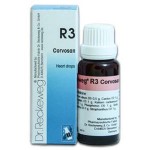
Dr. Reckeweg R 3 Corvosan Heart Drops Indications: Heart insufficiencies of a light to medium degree, with a tendency towards oedema. Myocardial weakness in cases of valvular heart diseases. Dilatations. Post-infectious myocardial weakness. Degenerative processes of the myocardium, coronary insufficiencies, cardiac infarction, functional irregularities, myo- and endocarditis, hypotonia. Mode of action of main Ingredients: Increases muscular strength of the heart, caused by the following group. Cactus: Oppression with symptoms of angina pectoris. Strong pulse, suffocation. Crataegus: Myodegeneratio cordis with cardiac weakness; enfeeblement of the heart during infectious diseases. Painful spasms; hypotension; tendency towards decompensation; functional irregularities. Digitalis: Heart failure with cardiac dilatation. Kalium carbonicum: Weakness of the heart and the cardiovascular system in endo-myocarditis. Sharp pain in the heart. Kalmia: Pains extending down left arm. Chronic heart weakness with difficult breathing. Acute and chronic endocarditis, following gout and rheumatism. Phosphorus: Heart palpitations mainly when resting on the left side, afflux of blood to the chest and suffocation, anguish. General nervous exhaustion and hypersensitivity. Scilla: Insufficiency of the cardiovascular system with dysrhythmia. Decompensation phenomenon. Spigelia: Strong and abnormal palpitation, low pulse, endo-myocarditis. Strophanthus: Fast acting heart tonic Dosage: According to the weakness of the heart, 3 times daily 10-20-30 drops in some water, in the beginning of the treatment even 4-6 times daily.In case of strong tendency towards hydropsy, to be taken undiluted. Improvement should follow after several days only. If not, the dose should be increased, and reduced again after improvement to 20 drops, 3 times a day. Even after complete disappearance of the complaints a treatment of 10-15 drops 2-3 times a day should be continued for a longer period of time. Overdosing presents no danger. In acute weakness of the heart, every 15 to 30 minutes 10-20 drops. Remarks: In cardiac neurosis, angina pectoris etc., use R2 Gold drops.In myocarditis and endocarditis administer additionally R22.Decompensated heart: R58.In myocardial infarct: R67 and R2, follow-up with R3.Cardiac arrhythmias: R66.Cardiac neurosis: R22.
Dr. Reckeweg R 2 Aurin Essentia aurea-Gold drops Indications: Organic and functional affections of the heart, mainly cardiac neurosis. Nervous perturbations. Arrhythmia, tachycardia, extrasystoles, constrictions, angina pectoris, coronary insufficiencies. Strong pulse, palpitations, excitations, anguish and oppression of the heart, vegetative dystonia. Mode of Action of Main Ingredients Arnica: Painful sensation in the heart. Nervous heart trouble. Aurum chloratum: Main action on: Myocardium, aorta and coronary artery. Heart oppressions and dilatations, afflux of blood to the head, precordial pains. Cactus: Sensations of suffocation, strong pulse, oppression. Stenocardia and angina pectoris. Crataegus: Excellent tonic for heart and blood circulation. Myocardial weakness and hypotonia. Digitalis: Heart tonic in case of cardiac weakness. Ignatia: Various nervous sensations of the heart, mainly following affections of a depressing nature (anxiety restlessness). Also in general nervous irritation and sleeplessness. Kalium phosphoricum: General nervous exhaustion, anaemia and myocardial weakness. Conduction disturbances. Laurocerasus: Cyanosis with myocardial insufficiency. Pressure and pain in the chest. Spigelia: Strong and abnormal pulsations, visible and perceivable. Pain extending down left arm. Valeriana: Nervous agitations, changing humour, nervous hypersensitivity. Functional affections of the heart, strong pulse, cardiac nervousness. Dosage: According to graveness, in the beginning 3-6 times a day 10-15 drops in some water.In acute cardiac affections, every ¼ - ½ hour 10-15 drops until improvement sets in. Remarks: In myocardial insufficiencies of light to medium degree, use R3.In gastro-cardiac symptoms, additional use of R5, 1-3 times a day 10-15 drops before or after meals.In cardiac arrhythmias: R66 or R22.In acute myocardial infarct: give in alternation every ½ - 1 - 2 hours 10-15 drops of: R 2, R67 and R55.Follow-up treatment with R3, also R44.
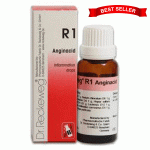
Dr. Reckeweg R 1 Anginacid Inflammation Drops Size: 22ml Indications: Local inflammations, acute and chronic, of catarrhal, with swelling of the glands. Sudden infections and high fever, with irritations of the meninges, conjunctivas and pharynx. In particular: Inflammations and suppurations of the Iymphatics of the pharynx, mainly all forms of tonsillary angina, tonsillitis, scarlet fever, otitis media, conjunctivitis, iridocyclitis, meningitis, inflammations of the maxillary sinus and of the dental roots. Inflammations of glands; mumps, orchitis, pancreatitis, cholecystitis, appendicitis, parametritis, bartholinitis. Acute rheumatic polyarthritis, monarthritis, arthritis urica. Lymphadenitis, Iymphangitis, phlegmonous inflammations, abscess, withlow, furuncles and carbuncles, erysipelas, quinsy. Mode of Action of Main Ingredients Apis mellifica: Inflammatory infiltrations, edematous swellings. Barium chloratum: Chronic diseases with swelling and suppuration of the glands in different scrofulous affections of children. Belladonna: Inflammatory hyperemia of skin, of mucous membranes and glands. High fever. Aridity of the mucosa, delirium, moist feverish skin. Calcium jodatum: Chronic tonsillitis of children, scrofulous increase of Iymph nodes on neck and nape. Hepar sulfuris: Tendency for catharzic inflammations and pyesis. Kalium bichromicum: Plastic exudation of mucous membranes in nose, pharyngeal cavity and pharynx. Viscous, stringy mucus. Mucosae ulcer. Marum verum: Adenoid vegetation, chronic catarrh of the postnasal space. Mercurius sublimatus corrosivus: Acute inflammations of the mucosa involving the glands, sticky perspirations. Phytolacca: Swelling and dark reddening of the pharynx and tonsils, radiating pain up to the ears. Dosage: In case of acute infections with high fever, in the beginning 10-15 drops in some water every ½ hour for ½ - 1 day.Same treatment to be followed in case of purulent inflammations (e.g.: inflammations of the tonsils or furuncles). After improvement, take same dose every 1-2 hour. After recovery it is advisable to take 10-15 drops 2-3 times a day for about a week.Chronic inflammations: 2-3 times a day 10-15 drops.Constitutional modifications in chronic glandular hypertrophy of children; once a day 5-8 drops in some water for a longer period of time. Remarks: In case of influenza, use R6.In case of chronic arthritis, use R11.In acute polyarthritis (i.e. rheumatoid arthritis) administer R24 in alternation with R1 every one to two hours to begin with.In ovaritis: administer R24 in alternation with R1.In adnexitis-parametritis administer additionally R38 and R39, 2-3 times daily. In chronic paroxysmal appendicitis: once daily R1, R24 and R38,10-15 drops of each.In acute appendicitis until surgery R24 and R38, 10-15 drops alternatively every one to two hours.Teething difficulties: see R35.Bronchitis: see R48 and R57; if necessary also Jutussin® R8 and R9.Whooping cough: see Jutussin® drops R9 and syrup R8.Muscular rheumatism and chronic rheumatism of joints: see R11 and R46.Nephrolithiasis: see R27.Cysto-pyelitis: see R18.Pleuritis: see R24.Proteinuria subsequent to tonsillitis quinsy or nephritis: administer additionally R64. Influenza, use R6.Pancreatitis: see R72.
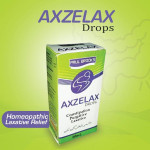
**ایگزلیکس - قبض کے لیے قدرتی اور نرم علاج** ایگزلیکس قبض کے لیے ایک نرم اور قدرتی علاج ہے۔ یہ آنتوں کی باقاعدہ حرکت اور نظامِ ہضم کے آرام میں مدد دیتا ہے۔ سنا مکی (Cassia Angustifolia) اور Cascara Sagrada کی طاقت سے بنا ہوا، یہ قبض کو محفوظ اور مؤثر طریقے سے دور کرنے میں مدد کرتا ہے۔ **دستیاب ہے Bachat.vip پر - آل پاکستان ڈیلیوری**
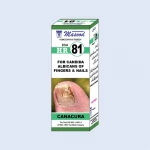
HR 81 is the best homoeopathic remedy for fungal infection. Indicated in fungal infections of fingers and nails. Effective for skin problems like itching, burning and stinging. Promotes the healing process after injury to the skin. Used in the treatment of eczema or psoriasis. Also helpful in the prevention of pus formation in wounds.
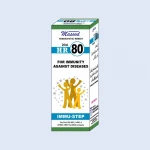
HR 80 is used to boost up the immune system. Indicated in lethargy and weakness after disease. Promotes the body natural healing system. Provides nutritional support for healthy immune system. Used in stretched muscles and to overcome stiffness.